 Uniswap
 concentrated liquidity uses price ranges to determine trading exposure and swap-fee eligibility
Uniswap concentrated liquidity allocates capital to chosen price ranges, which determine fee eligibility and the changing composition of pool tokens. A liquidity provider (LP) supplies a position with lower and upper bounds. Swaps use its liquidity while the pool trades within that interval. Outside its bounds, the position's principal consists of one token, and it earns no new swap fees until the price enters its range. Uniswap v3 introduced this arrangement, and v4 retains it within its standard concentrated-liquidity pools. Range width controls where capital supports trading; tick spacing constrains valid boundaries. Fee income also depends on trading activity and the position's share of active liquidity.
Updated ·
An in-range position shares LP fees with competing active liquidity, so a narrower range alone does not establish its returns.
Range width and trading depth
A narrower range around the same pool price concentrates a given deposit into more liquidity for that interval. That depth can support swaps with less price impact while trading remains within the covered prices. A wider range spreads the same capital across more prices and accommodates larger movements before becoming inactive. Trading volume and competing active liquidity determine how much of the resulting swap fees reach a position. Changing token values also affect its overall return.
Ticks, fee tiers, and permitted boundaries
Ticks mark discrete price boundaries, and tick spacing sets which of those boundaries a liquidity position can use. At tick i, the underlying token1/token0 ratio is 1.0001 i , before adjusting for token decimals. Each upward tick multiplies that raw ratio by 1.0001. Equal tick steps therefore represent equal proportional changes, rather than equal currency amounts. The pool price can move between usable boundaries; it does not jump only in tick-spacing increments. Reversing the displayed token price also reverses the apparent direction of the range.
Selected v3 fee configurations
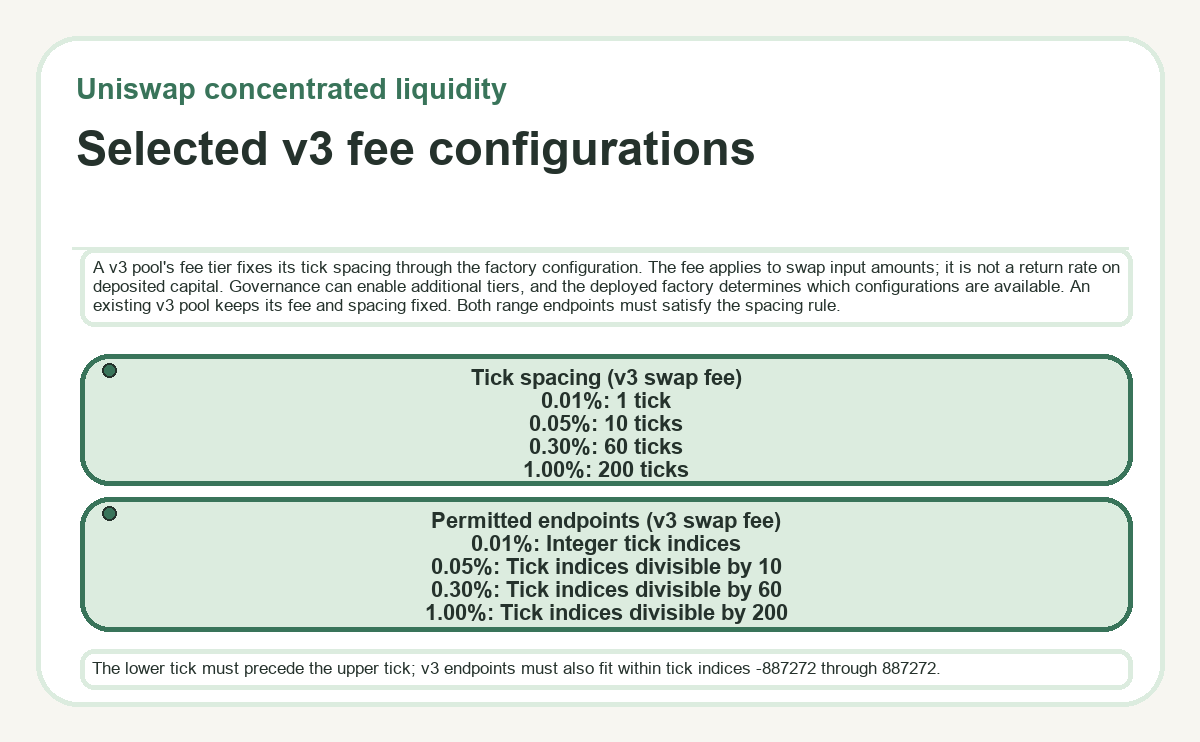
A v3 pool's fee tier fixes its tick spacing through the factory configuration. The fee applies to swap input amounts; it is not a return rate on deposited capital. Governance can enable additional tiers, and the deployed factory determines which configurations are available. An existing v3 pool keeps its fee and spacing fixed. Both range endpoints must satisfy the spacing rule.
Selected v3 fee configurations
A v3 pool's fee tier fixes its tick spacing through the factory configuration. The fee applies to swap input amounts; it is not a return rate on deposited capital. Governance can enable additional tiers, and the deployed factory determines which configurations are available. An existing v3 pool keeps its fee and spacing fixed. Both range endpoints must satisfy the spacing rule.
- Tick spacing (v3 swap fee) 0.01%: 1 tick 0.05%: 10 ticks 0.30%: 60 ticks 1.00%: 200 ticks
- Permitted endpoints (v3 swap fee) 0.01%: Integer tick indices 0.05%: Tick indices divisible by 10 0.30%: Tick indices divisible by 60 1.00%: Tick indices divisible by 200
The lower tick must precede the upper tick; v3 endpoints must also fit within tick indices -887272 through 887272.
| v3 swap fee | Tick spacing | Permitted endpoints |
|---|---|---|
| 0.01% | 1 tick | Integer tick indices |
| 0.05% | 10 ticks | Tick indices divisible by 10 |
| 0.30% | 60 ticks | Tick indices divisible by 60 |
| 1.00% | 200 ticks | Tick indices divisible by 200 |
The lower tick must precede the upper tick; v3 endpoints must also fit within tick indices -887272 through 887272.
Swap-fee shares and collection
In standard v3 accounting, an active position's fraction of LP swap fees equals its liquidity divided by total active liquidity. Total pool deposits include inactive ranges, so total value locked does not describe the fee-sharing denominator. A swap that crosses position boundaries encounters a changing set of active liquidity. The contract accounts for fees across those segments as it moves through the pool.
The v3 tier measures the fee charged on swap input, before any enabled protocol-fee deduction. A provider receives its share of the amount left for LPs. Governance-controlled protocol settings can change that allocation without changing the pool's tier. Network gas for liquidity management and fee collection creates separate costs. A fee percentage therefore does not establish an annual return or the net proceeds from managing a position.
Fee balances by version
Accrued fees and principal represent different balances, even when both use the same pool tokens. Principal quantities follow the range curve at the current pool price. In v3, swap fees accrue in the input token, so trading in both directions can build fee balances in both tokens. Stored owed-token balances can also include withdrawn principal awaiting collection. Treating every owed token as fee income would overstate earnings.
Uniswap v3 collection
The v3 NonfungiblePositionManager represents positions as ERC-721 non-fungible tokens (NFTs) and provides a collect operation for amounts owed. Collecting accrued fees can leave the position's liquidity unchanged. Reducing liquidity calculates withdrawn principal and adds it to the owed-token balances; collection transfers those balances to a recipient. Those operations can share a transaction through batching, so their conceptual separation does not require separate wallet submissions.
Uniswap v4 settlement
The v4 PositionManager credits accrued fees during liquidity operations. Fee collection can use a DECREASE_LIQUIDITY action with zero liquidity, followed by settlement of the amounts owed to the recipient. Zero liquidity means that collecting fees does not reduce principal liquidity. Increasing liquidity can use accrued fee credits toward the tokens owed for that increase. The final token amounts also reflect any applicable hook behavior.
What changes when the pool price leaves a position's range?
An out-of-range concentrated-liquidity position stops earning new swap fees from its underlying standard pool. Principal can become single-sided through swaps, or start that way when its range excludes the current price. With the pool's raw token1/token0 price orientation, a position below its lower bound holds token0 as principal. Above its upper bound, it holds token1. Previously accrued fees can still include either token. The range's liquidity stays recorded even while it contributes nothing to the pool's active liquidity. Single-sided principal remains exposed to that token's market value.
The existing position becomes eligible for LP swap fees when trading returns to its range, without changing its original boundaries.
v4 pool settings and hook conditions
Uniswap v4 separates tick spacing from fixed or dynamic LP fees while retaining the standard concentrated-liquidity mechanism. Dynamic-fee capability is fixed at pool creation; a configured hook can update the rate periodically or per swap. Depending on their permissions, hooks can affect liquidity changes and impose additional charges through custom accounting. Their logic matters to withdrawals and final payouts. Custom-curve hooks can depart from concentrated liquidity, so these range rules describe pools using the standard concentrated-liquidity curve.
Range changes and holding exposure
Changing a v3 range requires moving liquidity into a position with different tick bounds, because the existing NFT keeps its original range. Adding liquidity increases that position's size without moving its endpoints. Funding a replacement range may require a different token mix at the prevailing pool price. Removing liquidity, collecting tokens, and opening the replacement can incur network costs. An interface or manager may batch supported actions; the underlying position identities remain distinct. The v3 decreaseLiquidity call fails if either principal output falls below its specified token minimum.
Impermanent loss describes the value shortfall from supplying liquidity compared with holding the originally deposited tokens, before accounting for fees. The range curve changes token inventory as trades move the pool price. Narrower ranges concentrate that inventory change over a smaller price interval. Earned fees may offset the shortfall, while management costs reduce proceeds. Withdrawal returns the position's current token mix, which may differ from the initial deposit. Direct holding preserves token quantities; a concentrated position exchanges tokens along its curve and can add fee income while active.
Questions worth asking
Can i hold overlapping ranges within the same Uniswap pool?
A provider can hold multiple concentrated-liquidity positions whose price ranges overlap in the same pool. Each position has its own bounds and liquidity amount. Their active contributions add together where their intervals overlap. Splitting capital creates a chosen liquidity distribution; it does not multiply the deposited assets or guarantee that more positions earn more fees.
Why can a displayed boundary price disagree with a v3 position's active status?
A v3 position is active when the stored current tick is at least its lower tick and below its upper tick. Displayed prices may round away the difference. At an exact tick crossing, the stored tick can also reflect the direction of the last crossing. A rounded price label therefore cannot establish fee eligibility on its own.
Do in-range liquidity deposits require equal values of both tokens?
An in-range concentrated position uses a token mix determined by its chosen bounds and the current pool price. That mix can have unequal values, even before fees accrue. Supplying more of one token does not force the pool to accept an arbitrary deposit ratio. Near a boundary, the required principal increasingly favors the asset associated with that side.
Is a single-sided liquidity range a stop-loss order?
A basic single-sided range does not reproduce a stop-loss order. The range curve determines which asset can fund liquidity above or below the pool price. It cannot accept either token arbitrarily on either side. Range orders can approximate certain limit orders as price crosses their band, and reversal can undo that conversion before withdrawal.
Does transferring a v3 position NFT transfer control of its liquidity?
Transferring a standard v3 position NFT gives its new owner control over that position's liquidity and accrued tokens. The NonfungiblePositionManager restricts withdrawal and collection to the owner or an approved operator. Transferring the NFT leaves its pool and range intact. It does not send the underlying pool tokens into the recipient's wallet as spendable balances.